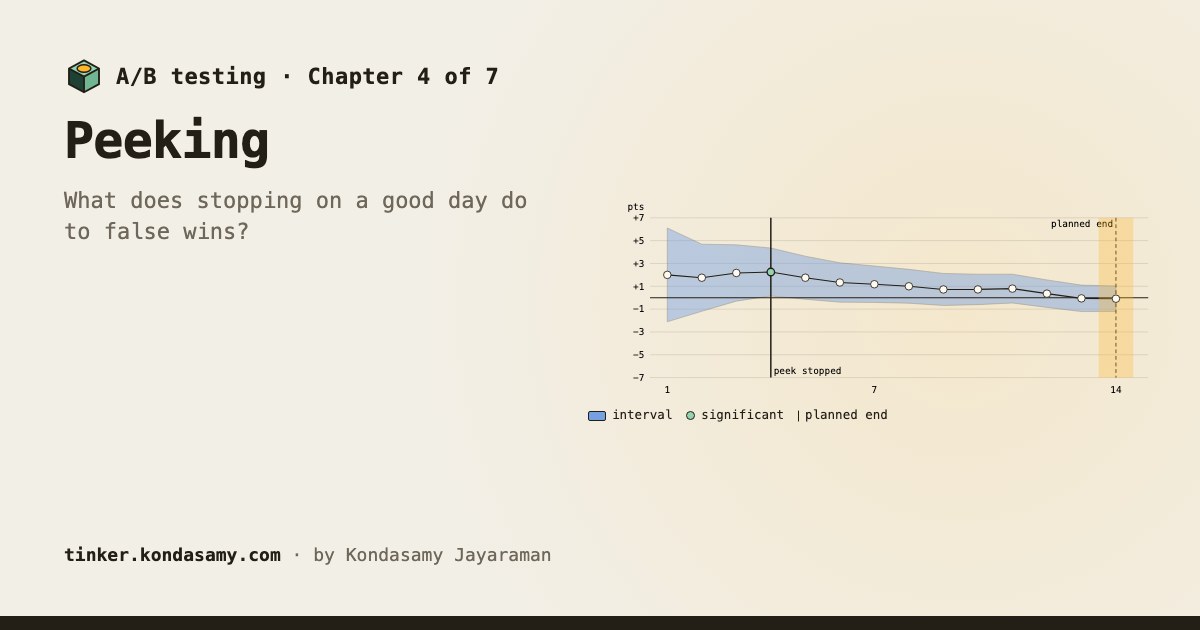
Peek on day 4
win?+2.3 pts
Significant, and pure luck.
Module 24 · A/B testing
Split shoppers at random, count who buys, and learn when a gap is real. Then meet the lucky days, early peeks and twenty-colour tests that fake a win, at Larkspur’s shop.
The whole idea in one example
+2.3 pts
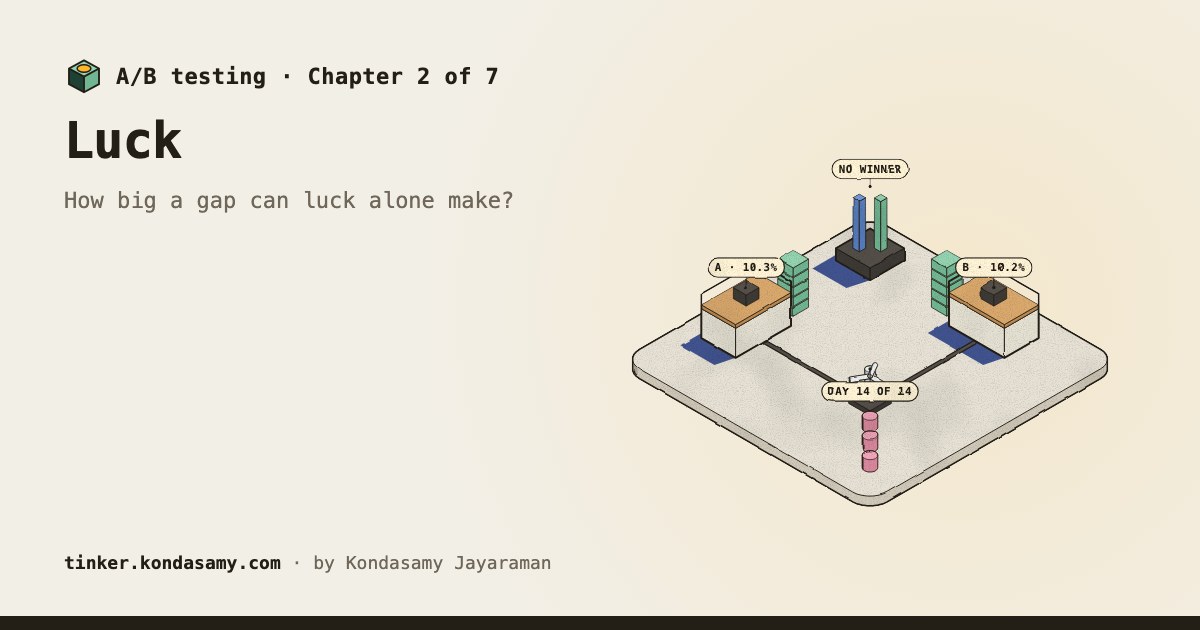
Significant, and pure luck.
No winner
The planned end keeps no win.
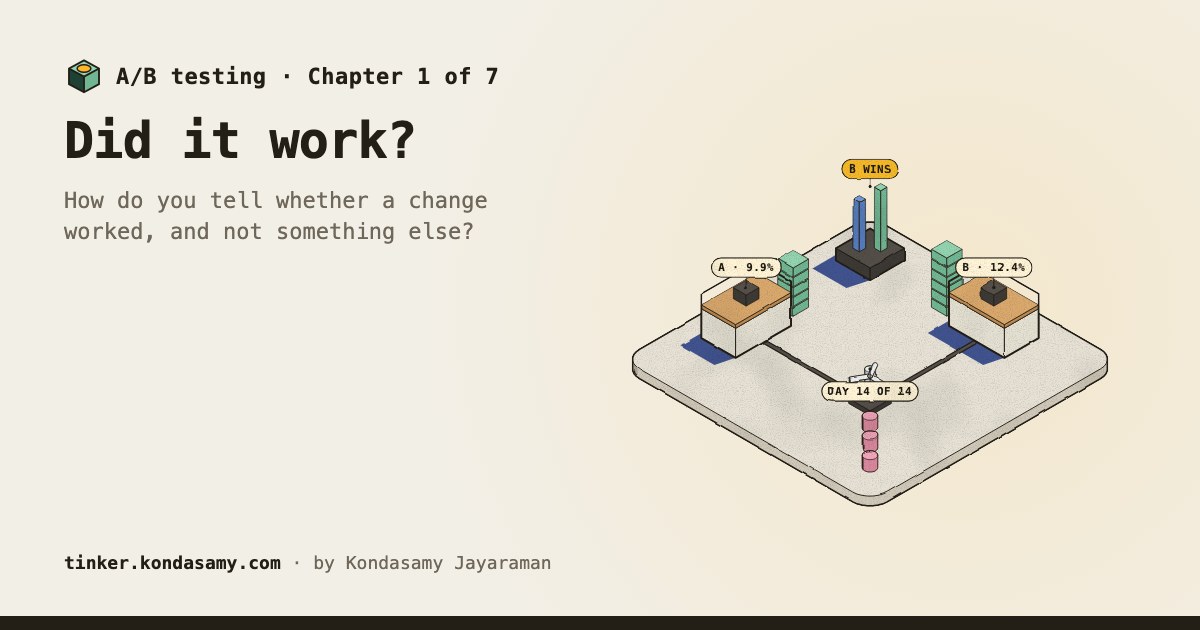
Rates come from simulated shoppers: Larkspur’s own traffic and rates, drawn from fixed seeds, not data from any real shop. The real one-page checkout in chapter 1 ends +2.5 points.
How it works
A coin flip decides who sees which checkout
Kohavi et al. (2009): in an A/B test users are randomly exposed to the control or the treatment, and no factor may influence who gets which, so a properly run test’s differences are caused by the change.
Source, checked 24 October 2026
Identical checkouts still land apart
Kohavi et al. (2009): an A/A test splits users into two groups but shows both the same experience; at a 95% confidence level it should declare a difference about 5% of the time.
Source, checked 24 October 2026
An early lead can be luck
Johari et al. (KDD 2017): users of A/B testing software watch results continuously while a test runs, and then the usual p-values and confidence intervals give unreliable inference.
Source, checked 24 October 2026
More orders, but more sent back
Kohavi et al. (2009): a good overall criterion is not short-term; with revenue alone you might plaster ads over a page, though many ads hurt the user experience.
Source, checked 24 October 2026
The story
Larkspur Supply Co. tests a new checkout, a bigger button, twenty colours and a pushy banner, and learns which wins are real. You’re the one who reads the results.
Played Evals? It asks the same “is B better?” of an AI assistant.
Your path
Chapter 6 · done
What if the number you tested rises while the business doesn’t?
Chapter 7 · done
Which experiments ship, which keep testing, and which stop?
Anyone who ships changes and reads test results, and wants to know when a win is real. The maths is folded away; the shoppers do the work.