1 step
roughness 0.63
A blurred average of every drawing.
Module 25 · Diffusion
An image model starts from random speckle and removes its best guess of the noise, step by step. Here you develop part drawings in a darkroom, count what each step costs, watch a network learn a shape, and steer it with a label.
The whole idea in one example
A blurred average of every drawing.

A clean hinge.
Both run the same toy denoiser on Larkspur’s twelve 32 × 32 part drawings. It is a toy that shows the mechanism, not any real model’s numbers.
How it works
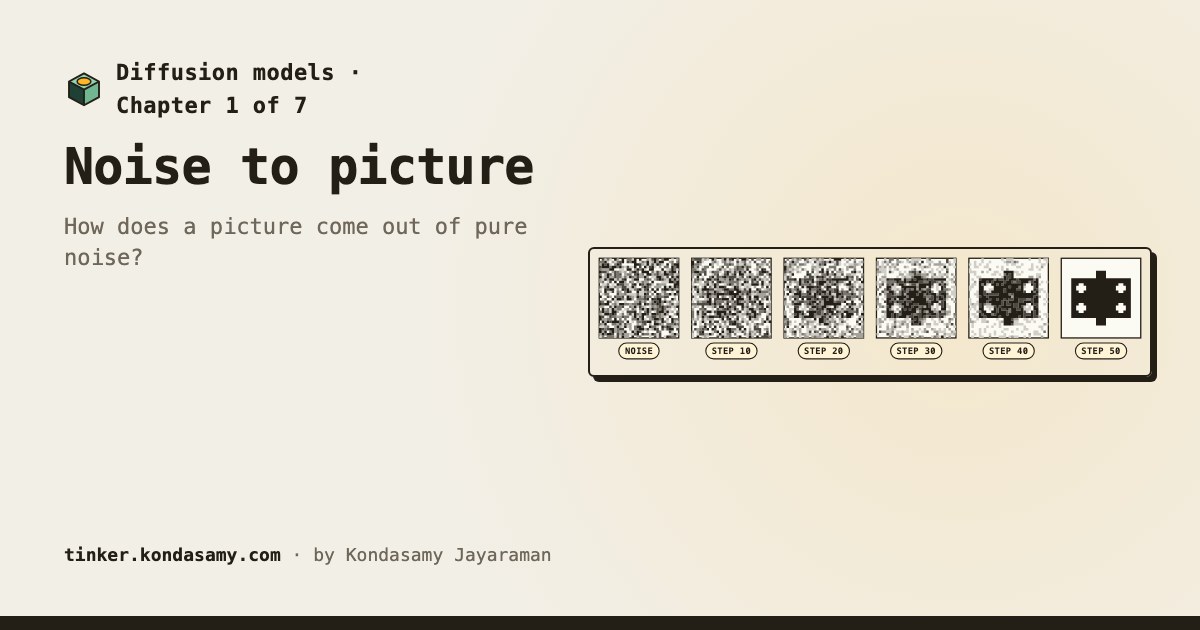
Start from noise; clean every pixel a little each step
Song and colleagues (2021) describe a diffusion model as noise added gradually and then removed in reverse: “Creating noise from data is easy; creating data from noise is generative modeling.”
Source, checked 24 October 2026
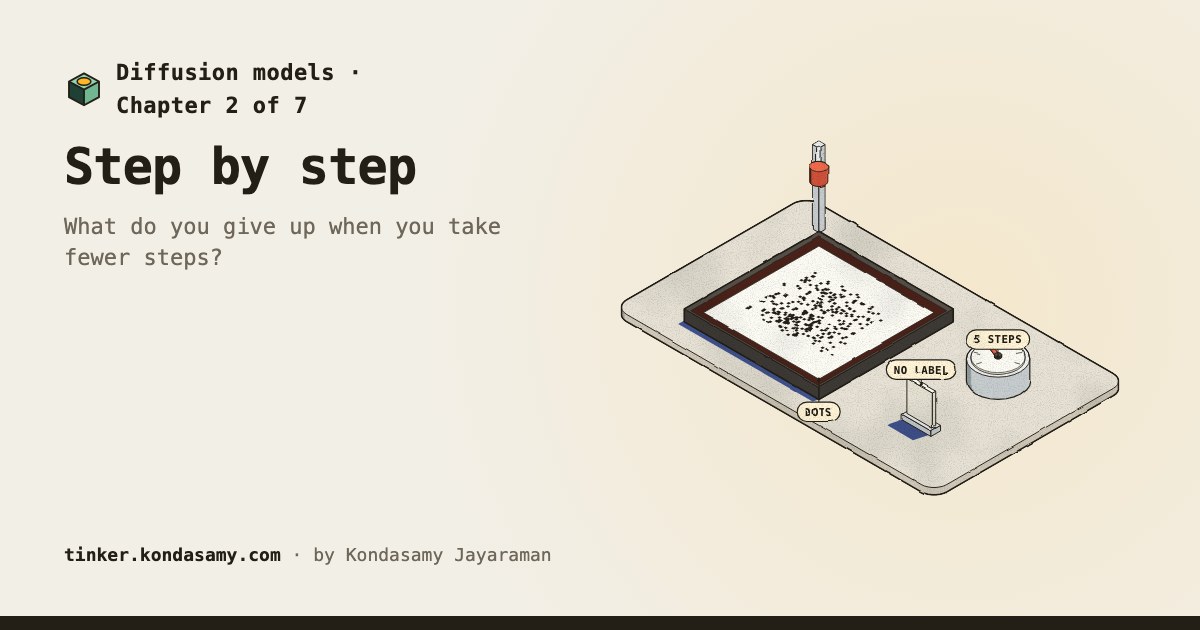
Fewer steps cost less and draw rougher
Ho, Jain and Abbeel’s 2020 paper (DDPM) made high-quality pictures with a diffusion model. It set T = 1,000 steps for all its experiments, so sampling one picture runs the network 1,000 times.
Source, checked 24 October 2026
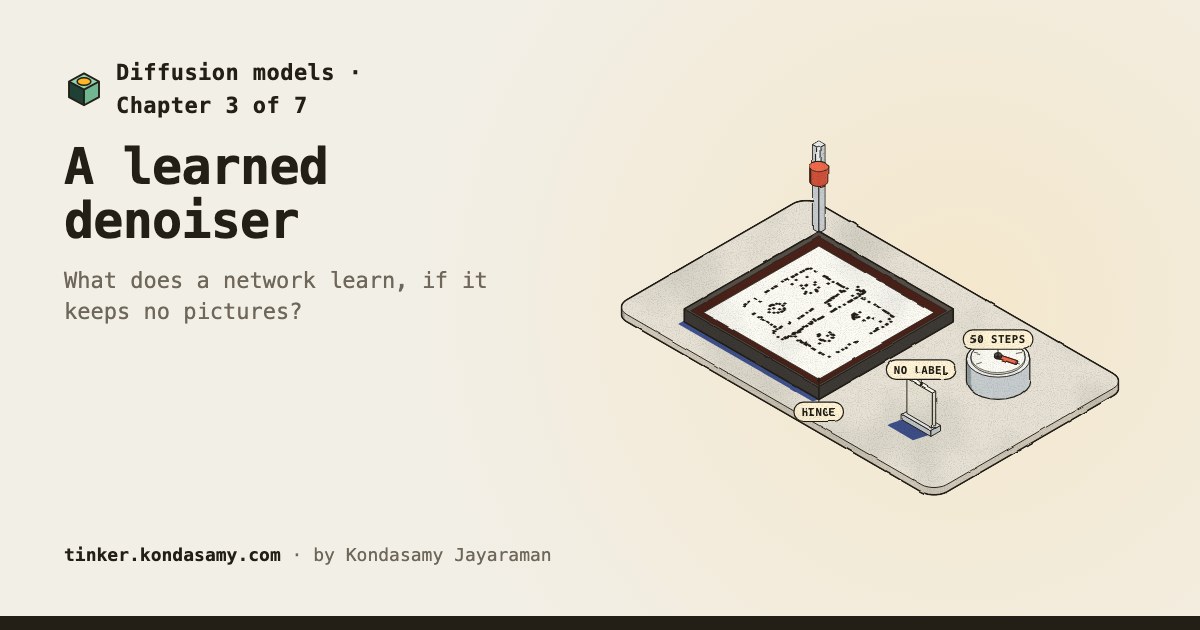
A network learns which way to move each dot
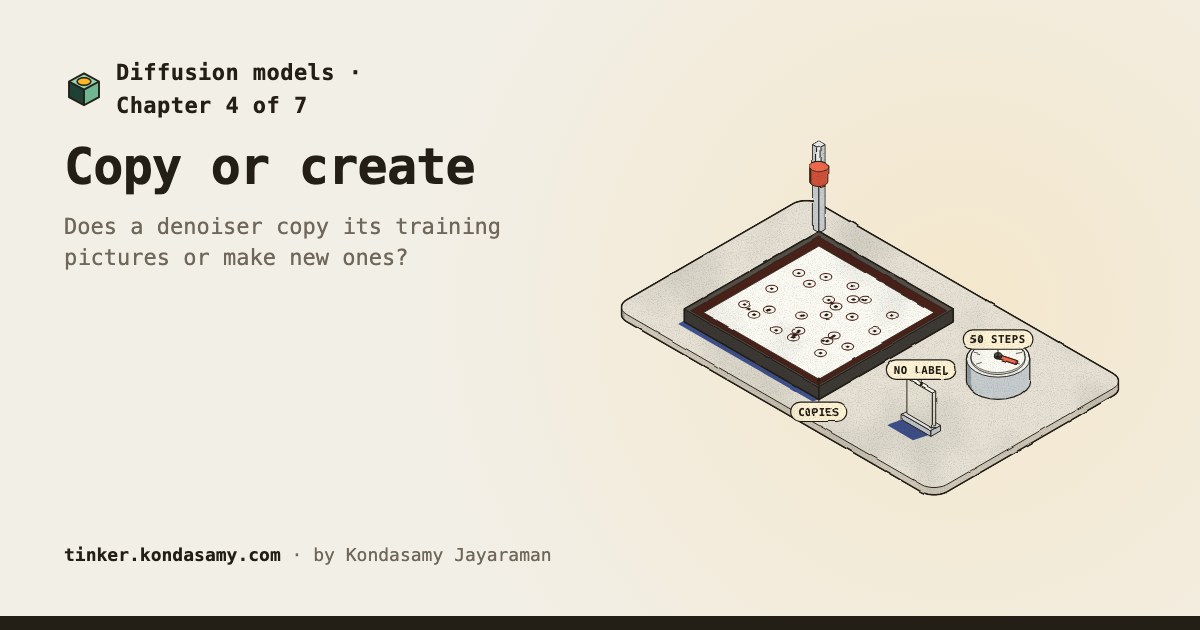
The ideal denoiser copies; a network makes new points
Carlini and colleagues (2023) showed that diffusion models memorise individual training images and emit them when generating, extracting over a thousand training examples from state-of-the-art models.
Source, checked 24 October 2026
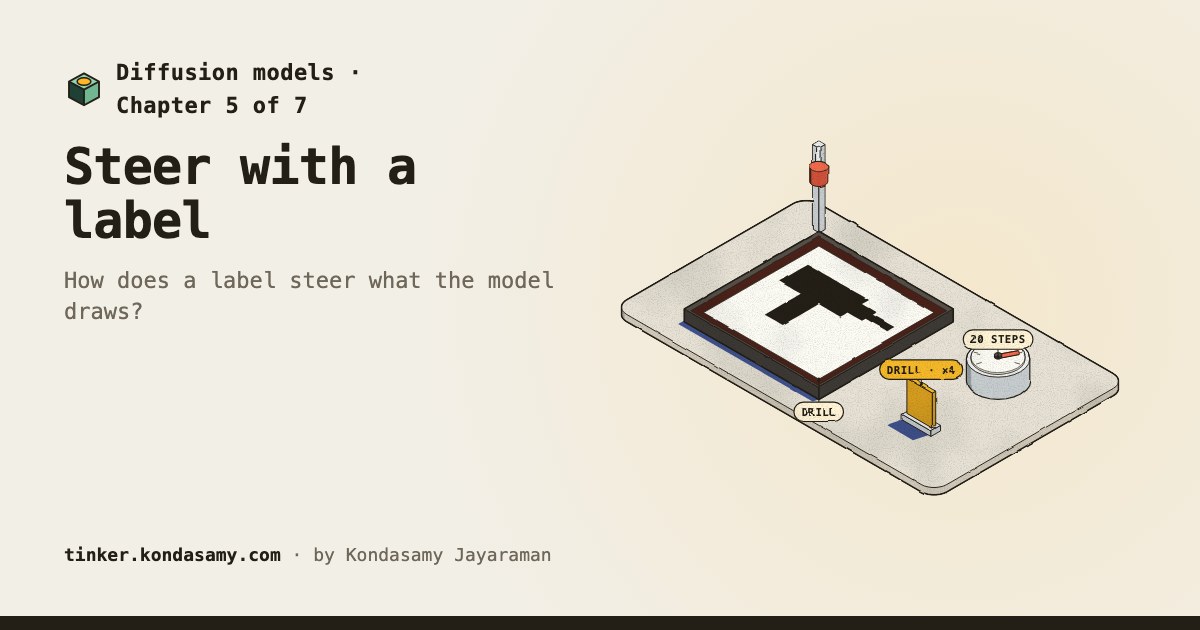
Guidance pushes toward the part asked for
Classifier-free guidance (Ho and Salimans, 2022) trains one model with and without the label, dropping it at random, and mixes the two predictions as (1 + w) × labelled − w × unlabelled, trading sample diversity for quality.
Source, checked 24 October 2026
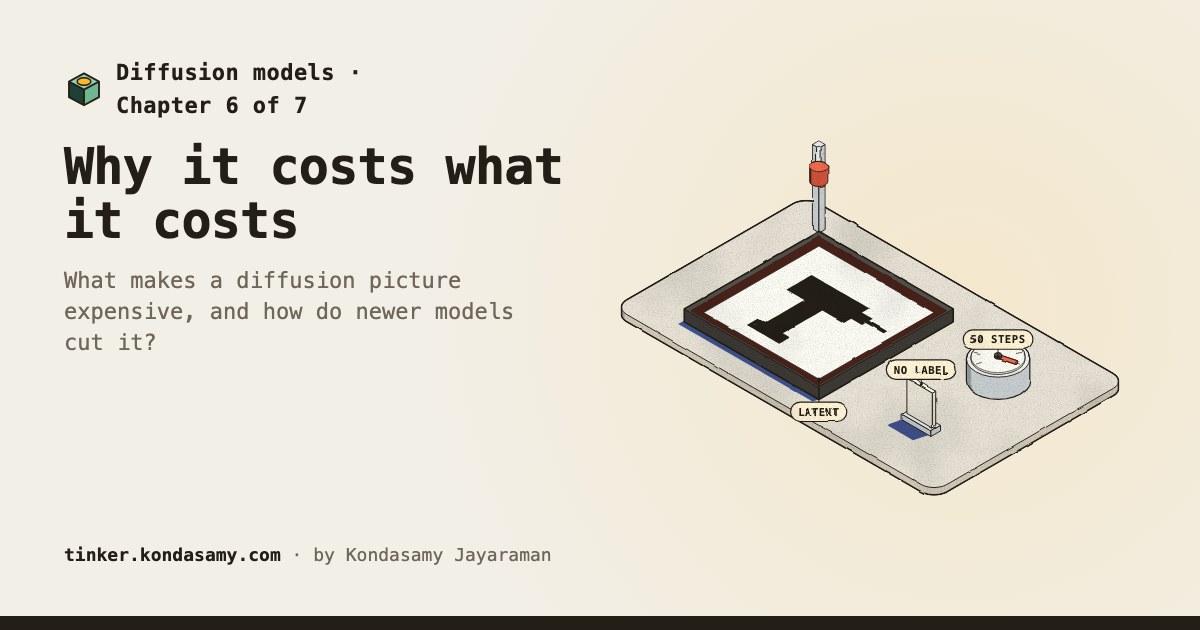
Steps × positions; latent and few-step models cut each
Latent diffusion (Rombach et al., 2022) runs the denoiser on a pretrained autoencoder’s smaller latent picture, shrunk by a factor f each way; the paper found f of 4 to 16 a good balance, with 4 and 8 best.
Source, checked 24 October 2026
Everything here runs live in your browser: the noise, an ideal denoiser over the drawings, and a small network trained once on the hinge’s outline. Latent diffusion shrinks the picture 8 times each way in the paper’s best settings.
The story
Larkspur Supply Co. wants pictures of its parts drawn by a model: a thumbnail for search and a clean image for every catalogue page. You’re on the team that decides how many steps and how much guidance each picture gets.
Multimodal models showed how pictures go into a model; here they come out. The workbench’s best plan is one of 2 that tie.
Your path
Chapter 6 · done
What makes a diffusion picture expensive, and how do newer models cut it?
Chapter 7 · done
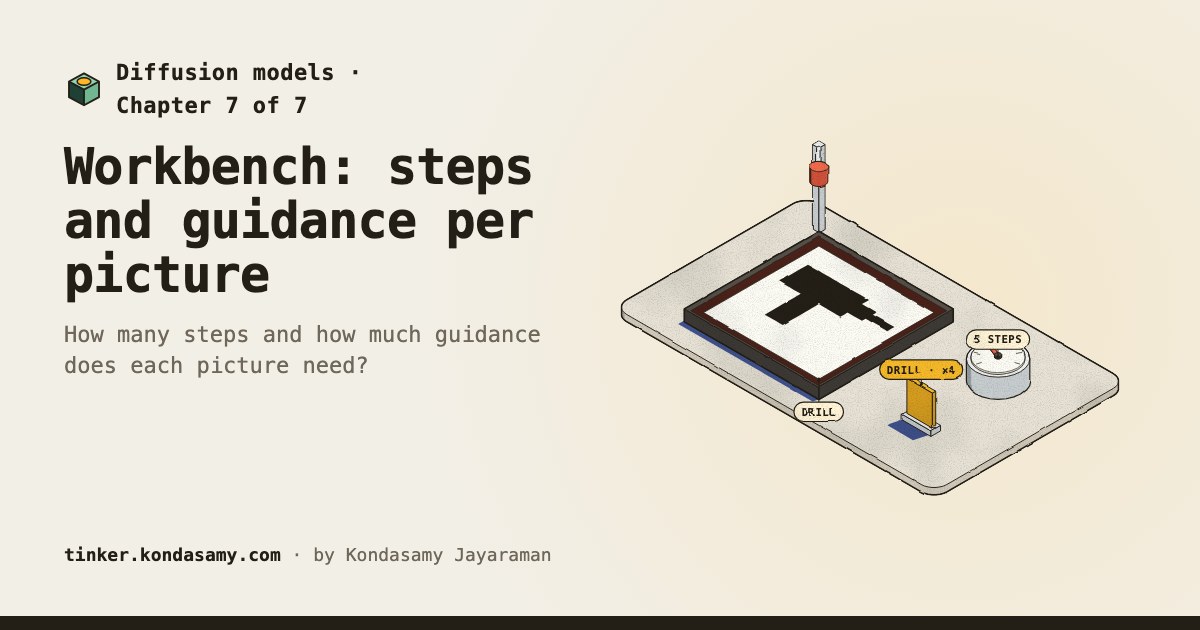
How many steps and how much guidance does each picture need?
Product managers, engineers and analysts choosing or paying for image generation. Multimodal models comes first; no code or maths needed.