by Kondasamy Jayaraman

Module 16 · Multimodal

Intermediate Tokens & embeddings recommended · by Kondasamy Jayaraman

How does a model read a picture?

Images become tokens too: small squares of pixels, counted and priced like text. Here you cut an invoice into patches, shrink it until the small print goes, read tables and handwriting two ways, and pick a method and a size for each kind of document.

Read as
OK

The whole idea in one example

The same invoice, sent small and sent large

400 px recorded reading

2 of 5 fields

180 image tokens

An invoice, probably from Brightwater Fasteners. The number looks like INV-20411 and the date reads 14 Sep 2026. Total $1,284.50. The order number and the small print are too small to read.

At 400 px only the biggest print survives. The invoice number’s last digit is a guess, and a wrong one.

1,600 px recorded reading

5 of 5 fields

2,610 image tokens

An invoice from Brightwater Fasteners to Larkspur Supply Co.: INV-20417, dated 14 Sep 2026, for order PO-5531. Three lines: brass hinges, BR-300 shelf brackets and a box of wood screws. Total $1,284.50, payment terms Net 30.

Every field right, small print included.

Both readings were written for this site to illustrate the cited findings; they were not measured on a real model. The fields are graded live by the Evals module’s key-fact check, and the token counts follow Anthropic’s published patch rule.

How it works

Six ideas carry the module

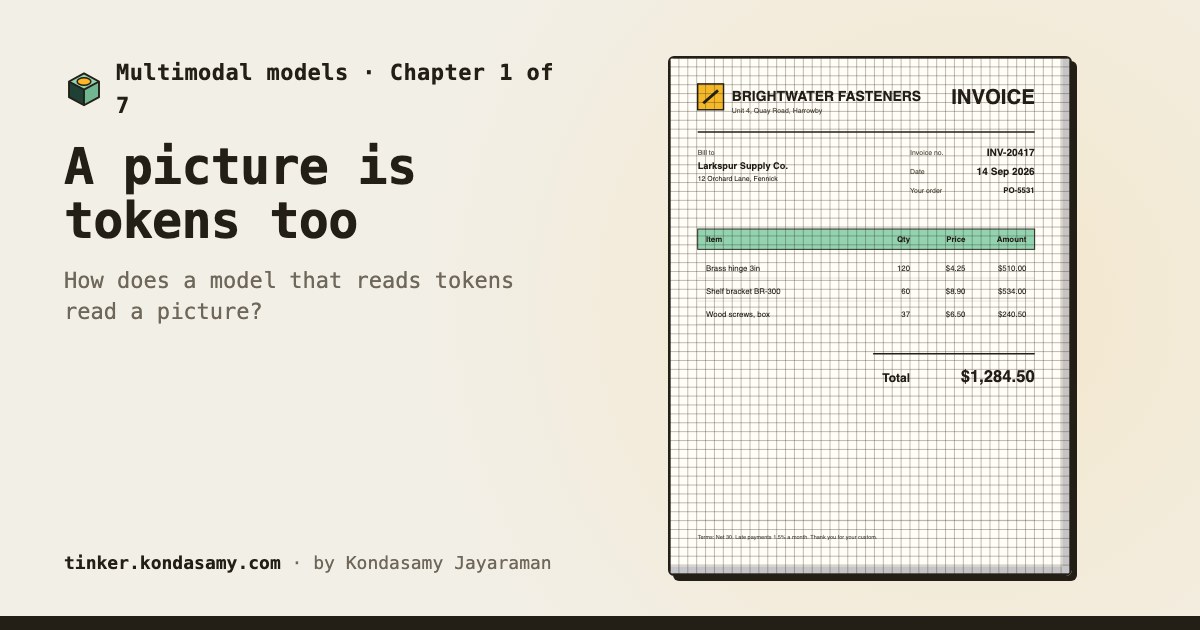
  1. The supplier’s invoice sent at 1,600 px, cut into 45 × 58 patches, 2,610 tokens

    1 A picture is tokens

    Cut into 28 px patches, one token each

    Claude views images in patches instead of pixels: each patch is a 28 × 28-pixel block, one visual token, so an image costs ⌈width / 28⌉ × ⌈height / 28⌉ tokens.

    Source, checked 21 October 2026

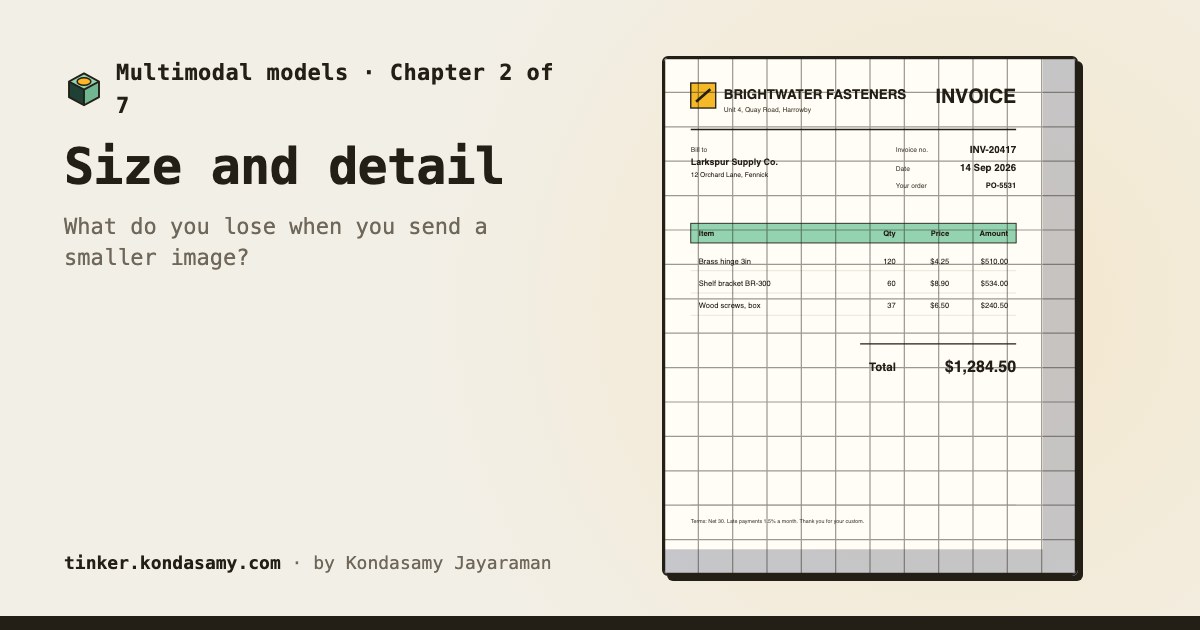
  2. The supplier’s invoice sent at 400 px, cut into 12 × 15 patches, 180 tokens

    2 Size and detail

    Fewer pixels, fewer tokens, and the small print goes first

    Anthropic advises that important text in an image should be legible and not too small, and warns that resizing a large image can make its text less legible.

    Source, checked 21 October 2026

  3. OK

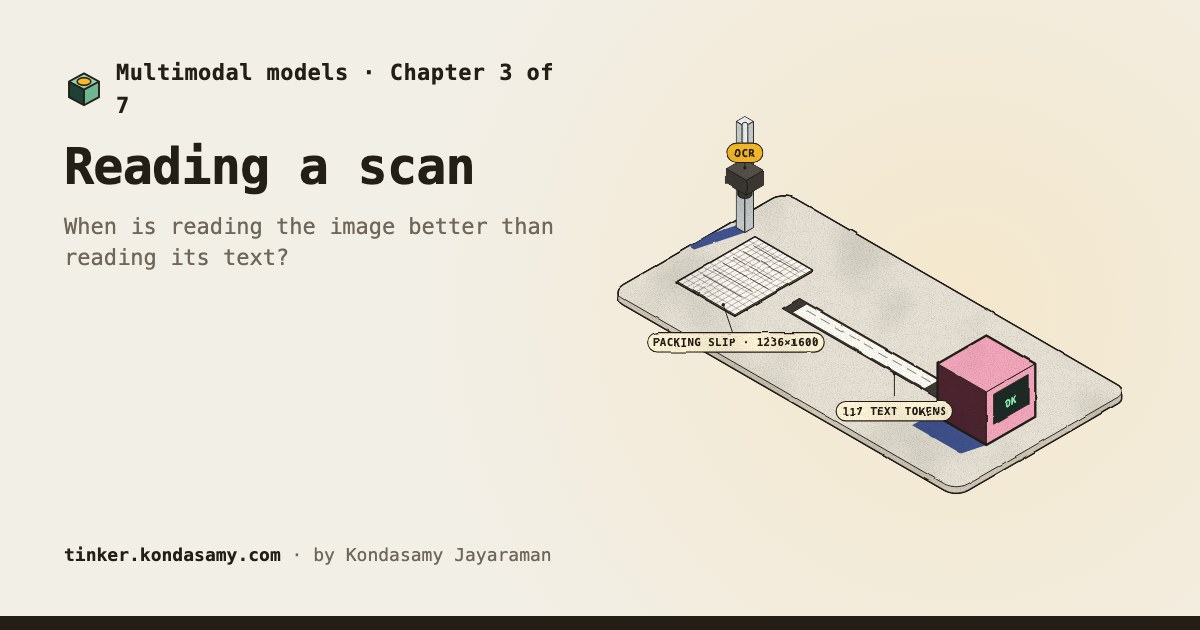
    3 Reading a scan

    OCR loses tables and handwriting; vision keeps the layout

    OCRBench, a 2023 study of large multimodal models reading text, found weak spots in multilingual text, handwritten text, non-semantic text and mathematical expressions.

    Source, checked 21 October 2026

  4. OK

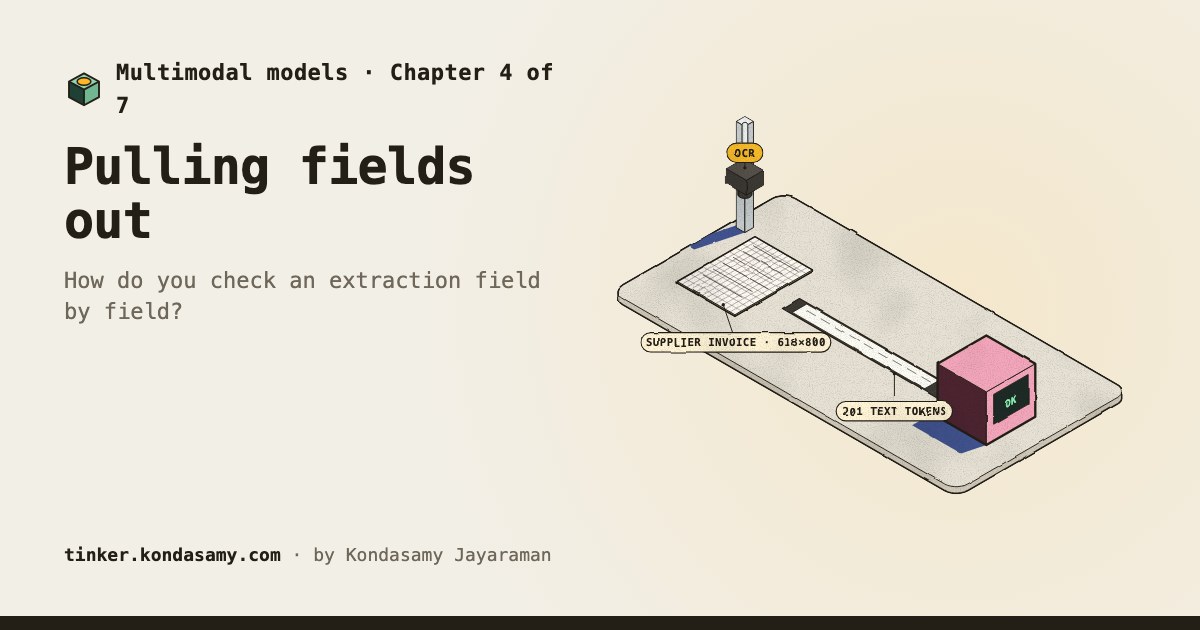
    4 Pulling fields out

    Grade every field against a reference, not one overall score

  5. OK

    5 Photos of parts

    When one angle can’t settle it, ask for another

    Anthropic’s listed limitations: Claude may make mistakes on low-quality, rotated or very small images (under 200 pixels).

    Source, checked 21 October 2026

  6. OK

    6 When pictures mislead

    Check what was read; text in an image is data, not orders

    OWASP lists multimodal injection under prompt injection: an attacker hides instructions in an image that accompanies harmless text, and the hidden prompt changes what the model does.

    Source, checked 21 October 2026

The documents and photos are drawn in code and rasterised in your browser at the size you pick. The readings were written per image, size and method to illustrate the cited findings; the grading and token counts run live.

The story

Larkspur’s assistant gets pictures

Larkspur Supply Co.’s assistant starts receiving pictures: supplier invoices, packing slips, notes from the warehouse and photos of broken parts. You’re on the team that decides how each kind of image is read, and checks what comes back.

Tokens showed how text becomes tokens; here pictures do. The workbench’s best plan is one of 3 that tie.

2,610
image tokens for one invoice at 1,600 px
195
text tokens for the same invoice read by OCR
0 → 3 of 3
handwritten note fields right, OCR then vision
78%
fewer tokens than “vision, largest size” for the same fields

Your path

The chapters

  1. Chapter 1

    A picture is tokens too

    How does a model that reads tokens read a picture?

  2. Chapter 2

    Size and detail

    What do you lose when you send a smaller image?

  3. Chapter 3

    Reading a scan

    When is reading the image better than reading its text?

  4. Chapter 4

    Pulling fields out

    How do you check an extraction field by field?

  5. Chapter 5

    Photos of parts

    What should the assistant do when a photo can’t settle the answer?

  6. Chapter 6

    When pictures mislead

    How can an image make the assistant wrong, or make it do something it shouldn’t?

  7. Chapter 7

    Workbench: pick a method and a size

    Which method and size should each kind of document get?

Who it’s for

  • Engineers
  • Product managers
  • Analysts
  • No code needed

Product managers, engineers and analysts sending documents and photos to a model, and paying for them. Tokens comes first; no code or maths needed.