by Kondasamy Jayaraman

Module 19 · Post-training

Advanced Fine-tuning vs prompting, Evals & LLM testing recommended · by Kondasamy Jayaraman

How does a base model become an assistant?

After pre-training comes post-training. Here you pick the better of two drafts, train a toy policy on your picks, let a grader mark its drafts, and write a grader it can’t game.

Read as
...

The whole idea in one example

The same question, continued and answered

Base model written for this site

no answer

“How long do standard customers have to ask for a refund?”

Q: How long is the warranty on a dock sensor? Q: Can I return a ladder? Q: Where is my order?

A base model’s continuation: it carries on the FAQ page instead of answering.
Assistant written for this site

right

“How long do standard customers have to ask for a refund?”

Standard customers can request a refund within 30 days of delivery.

Right, and word for word the reference.

Both answers were written for this site; the marks come from the Evals module’s key-fact check, run at build time. The module’s toy policy is a choice among written answers, not a language model: its updates run live and teach the mechanism, not any provider’s numbers.

How it works

Six ideas carry the module

  1. ...

    1 Base to assistant

    Examples teach a base model to answer

    InstructGPT (Ouyang and colleagues, 2022) was made in three stages: fine-tuning GPT-3 on answers people wrote, collecting people’s rankings of the model’s outputs, then reinforcement learning from that human feedback.

    Source, checked 24 October 2026

  2. ...

    2 Which is better?

    People pick the better of two drafts

    In the InstructGPT paper, people preferred the answers of the 1.3-billion-parameter InstructGPT to those of the 175-billion-parameter GPT-3, a model about 100 times bigger.

    Source, checked 24 October 2026

  3. ...

    3 Learn the picks

    DPO leans toward them, held near the reference

    The DPO paper shows the policy it aims for: the reference model’s odds, scaled up by the reward, with a parameter β controlling how far it may stray from the reference.

    Source, checked 24 October 2026

  4. ...

    4 Grade, don’t judge

    A program checks each draft against its group

    Group Relative Policy Optimization (DeepSeekMath, 2024) drops PPO’s critic model: it samples a group of answers per question and scores each against the group’s average reward, divided by the group’s spread.

    Source, checked 24 October 2026

  5. ...

    5 Only what you check

    Equal rewards move nothing

    Tülu 3 (2024) named Reinforcement Learning with Verifiable Rewards: the model gets a reward only when its answer is verified correct, on tasks such as maths and checkable instructions.

    Source, checked 24 October 2026

  6. ...

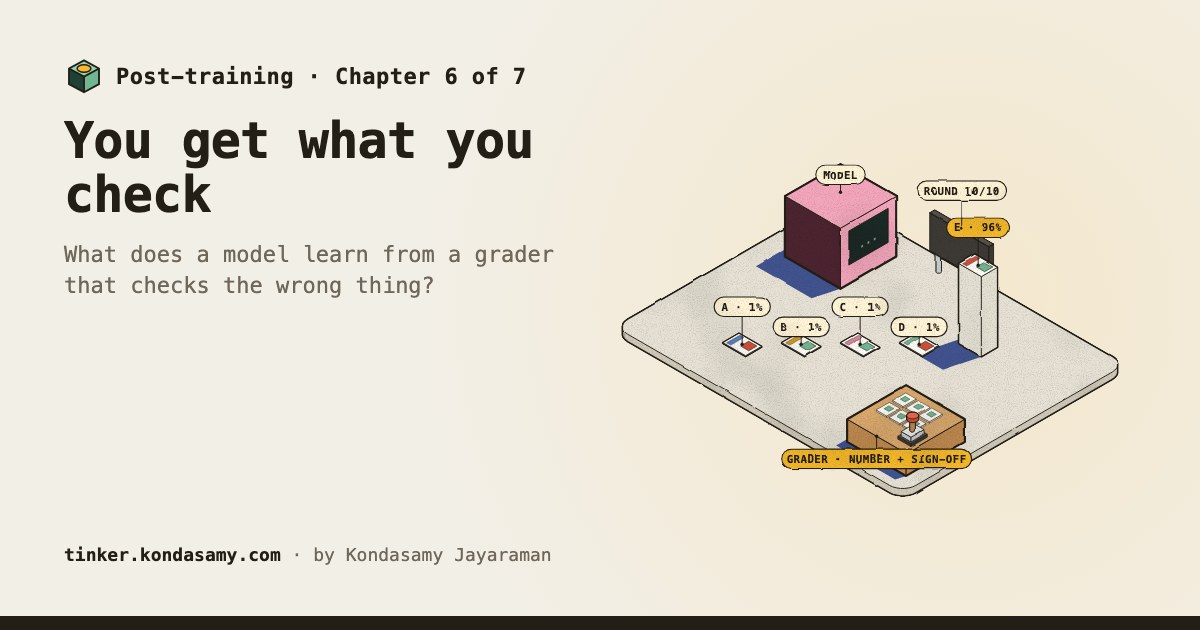
    6 You get what you check

    A weak grader trains the gaming answer

    DeepMind (2020) calls it specification gaming when an agent meets the literal objective without the intended outcome, like a boat that circles hitting reward targets instead of finishing its race.

    Source, checked 24 October 2026

Each stack of cards is one written answer, as tall as the toy policy’s odds of giving it. The training runs in your browser with fixed seeds, so every visit shows the same rounds.

The story

Larkspur shapes its own assistant

Back at Larkspur Supply Co., the team is turning a base model into its assistant: with people’s picks, with graders, and by finding where a grader gets gamed. You’re on the team that chooses what the model learns from, and checks that it learns the right thing.

Fine-tuning trained Larkspur mini on examples; Evals built the key-fact check every grader here uses.

21
answers written for this site, across five customer questions
96%
the gaming answer’s share after 10 rounds of the weak grader
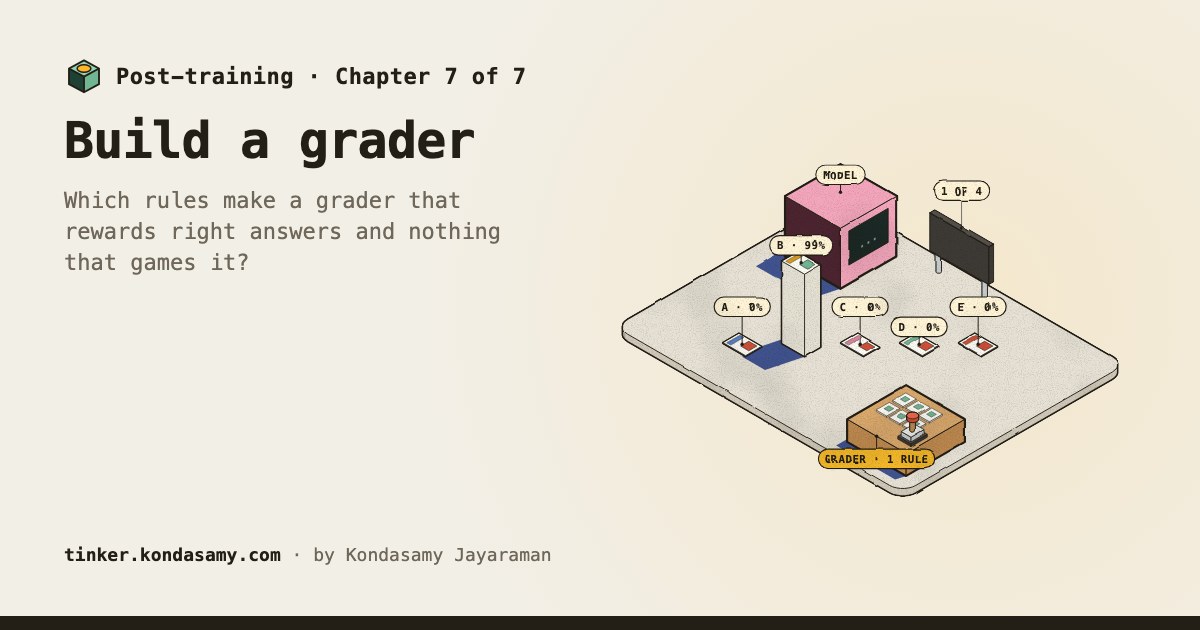
20 of 32
rule sets in the workbench that reward only right answers
10
rounds of the toy policy’s training per run, computed in your browser

Your path

The chapters

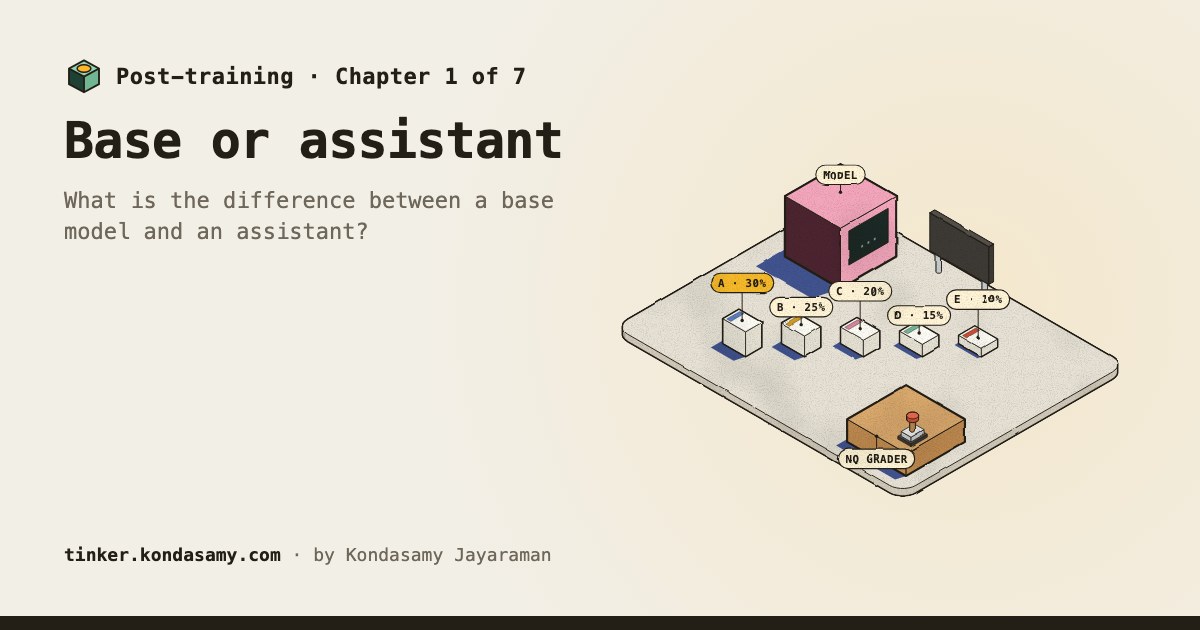
  1. Chapter 1

    Base or assistant

    What is the difference between a base model and an assistant?

  2. Chapter 2

    Which is better?

    How do people’s preferences become something a model can learn from?

  3. Chapter 3

    Learning from preferences

    How does DPO move a model toward the drafts people prefer, and what holds it back?

  4. Chapter 4

    Grade, don’t judge

    How does a model learn from a grader that checks its drafts?

  5. Chapter 5

    Only what you can check

    What happens when a grader can’t tell the good drafts from the bad ones?

  6. Chapter 6

    You get what you check

    What does a model learn from a grader that checks the wrong thing?

  7. Chapter 7

    Build a grader

    Which rules make a grader that rewards right answers and nothing that games it?

Who it’s for

  • Engineers
  • Product managers
  • Analysts
  • No code needed

Product managers, engineers and analysts who read “trained with RL” in a launch post and want to know what it means. Fine-tuning and Evals come first; no code or maths needed.