by Kondasamy Jayaraman

Module 9 · Fine-tuning

Advanced Evals & LLM testing, Transformer architecture recommended · by Kondasamy Jayaraman

Train the model, prompt it, or give it documents?

There are three ways to change what a model answers: what you tell it, what you hand it, and the weights themselves. Here you fine-tune a tiny model for real, measure what it learns and forgets, and decide which lever fits each job.

Read as
OK

The whole idea in one example

A price changes. Which version knows?

Fine-tuned recorded answer

wrong

“What does a Kestrel K2 scanner cost per unit when we order 50 or more?”

A Kestrel K2 costs $410 per unit when you order 50 or more. Cheers, the Larkspur team

The weights still hold the price from before training; nothing tells them it changed.
RAG recorded answer

right

“What does a Kestrel K2 scanner cost per unit when we order 50 or more?”

Since March 2, 2026, a Kestrel K2 handheld scanner costs $385 per unit when you order 50 or more, down from $410. Cheers, the Larkspur team

Cites the price update in its documents.

Price update, March 2026: “Price update. From March 2, 2026, the Kestrel K2 handheld scanner costs $385 per unit for orders of 50 or more, down from $410. Prices for 1 to 9 and 10 to 49 units are unchanged.” Both answers are recorded and graded by the Evals module’s key-fact check. Training put a voice and the facts of its day into the weights; only the documents moved when the price did.

How it works

Six ideas carry the module

  1. ...

    1 Three levers

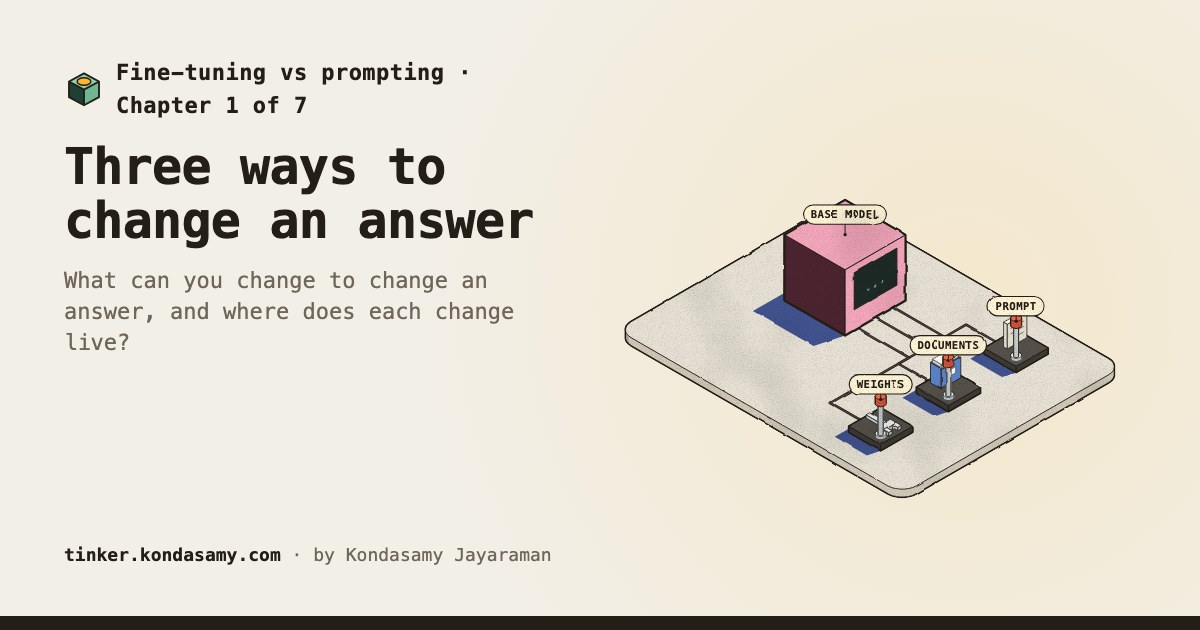
    A prompt, documents or the weights each change an answer

    OpenAI's model-optimization guide says prompt engineering may be all you need, and presents fine-tuning as an option for some tasks.

    Source, checked 21 October 2026

  2. OK

    2 Training moves weights

    Examples nudge every weight, once, ahead of time

    OpenAI's guide lists tasks fine-tuning suits, such as classification, a specific output format and fixing instruction-following failures, and training a smaller, cheaper, faster model to excel at one task.

    Source, checked 21 October 2026

  3. OK

    3 Small adapters

    Freeze the model; train a few small matrices beside it

    LoRA freezes a pre-trained model's weights and adds small trainable low-rank matrices to each layer of the Transformer.

    Source, checked 21 October 2026

  4. OK

    4 Learn less, forget less

    An adapter changes less, so less of the old model is lost

    Biderman and colleagues found that in the standard low-rank settings LoRA learns substantially less than full fine-tuning, but keeps more of the base model's performance outside the target domain: it learns less and forgets less.

    Source, checked 21 October 2026

  5. OK

    5 Forgetting

    What training adds can push out what the model knew

    Catastrophic forgetting is a neural network losing what it learned before when it is trained on something new; Kirkpatrick and colleagues note it was long thought to be unavoidable.

    Source, checked 21 October 2026

  6. OK

    6 Measure first

    An eval tells you which lever is worth pulling

    OpenAI's model-optimization guide starts with evals: measure the model's output to set a baseline, even before writing prompts.

    Source, checked 21 October 2026

The chapters run Larkspur mini in your browser, with real fine-tunes trained ahead of time. Its numbers teach the mechanism; they are not any provider’s.

The story

Larkspur wants its own voice

Back at Larkspur Supply Co., the team wants replies in the company’s own voice, and has to choose between a better prompt, better documents and training the model itself. You’re on the team that decides which lever to pull for each job, and proves it with an eval first.

Evals built the test set and the release gate; Transformers opened up Larkspur mini. This module trains it.

51,072
weights a full fine-tune of Larkspur mini trains
1,536
weights its rank-4 LoRA adapter trains
32
replies in Larkspur’s style set
10,000×
fewer trainable weights LoRA’s authors report for GPT-3

Your path

The chapters

  1. Chapter 1

    Three ways to change an answer

    What can you change to change an answer, and where does each change live?

  2. Chapter 2

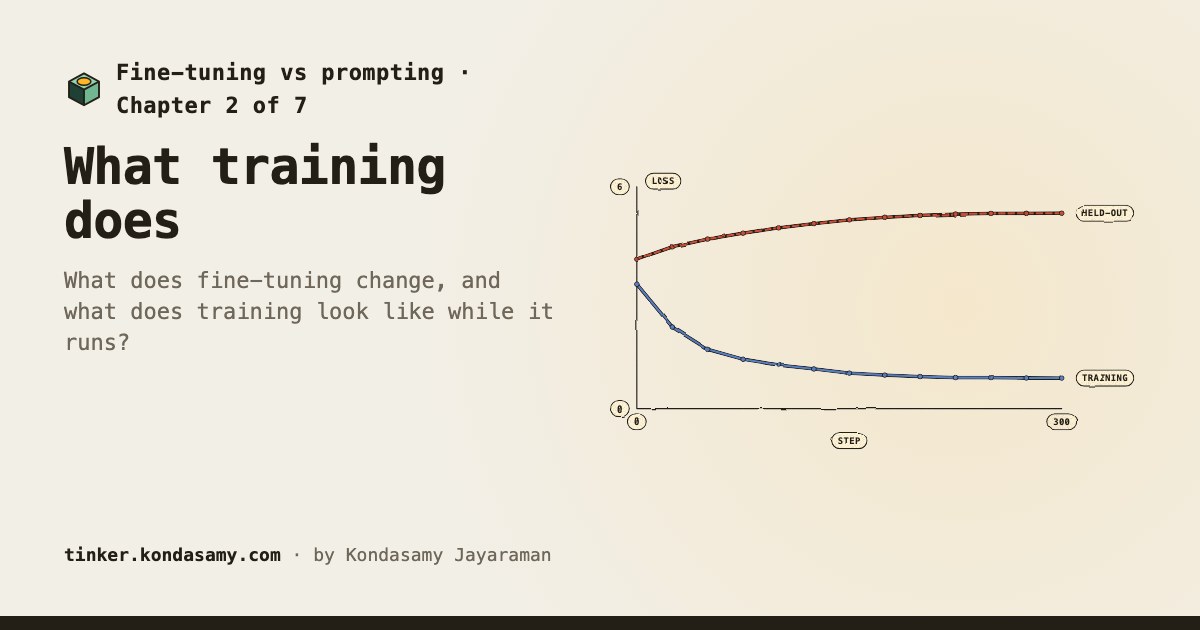
    What training does

    What does fine-tuning change, and what does training look like while it runs?

  3. Chapter 3

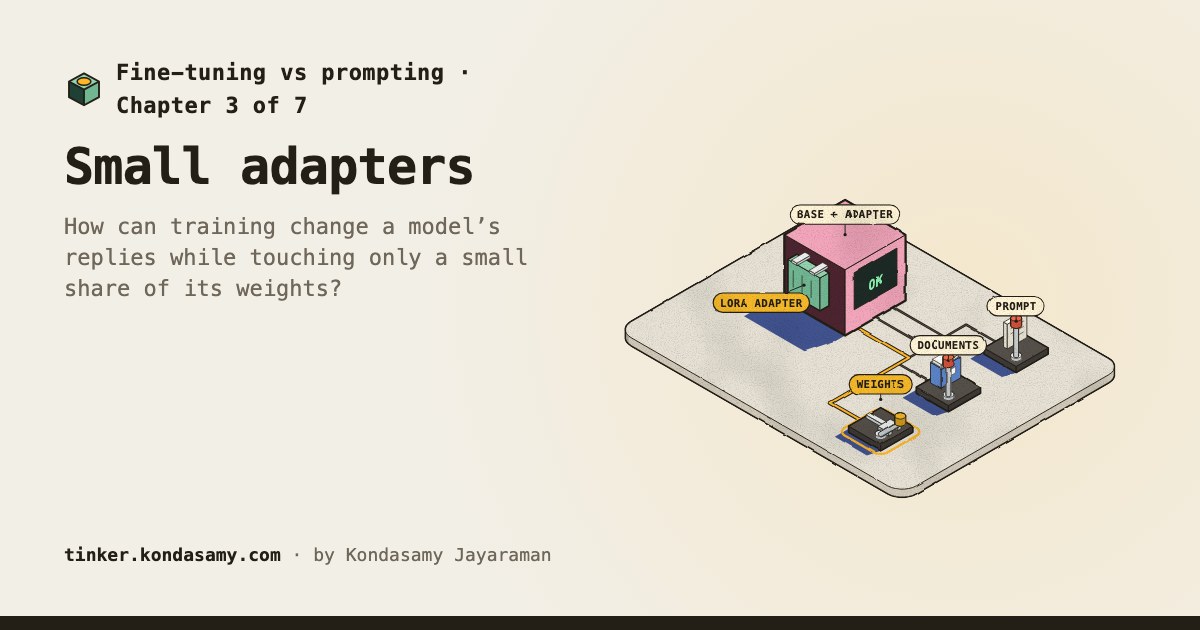
    Small adapters

    How can training change a model’s replies while touching only a small share of its weights?

  4. Chapter 4

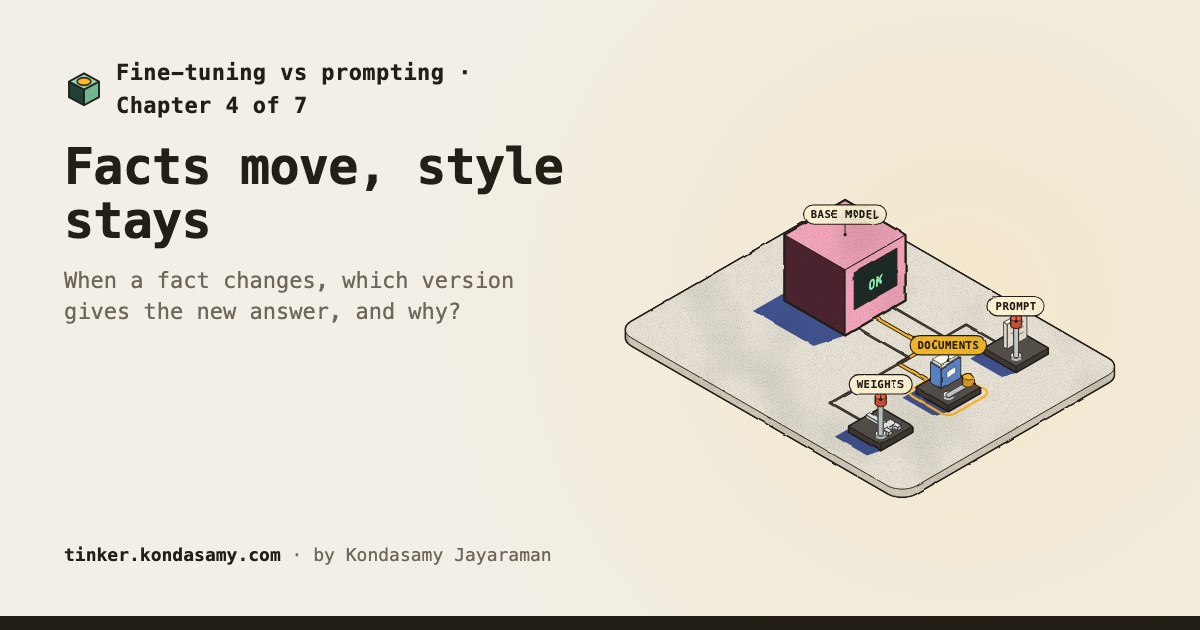
    Facts move, style stays

    When a fact changes, which version gives the new answer, and why?

  5. Chapter 5

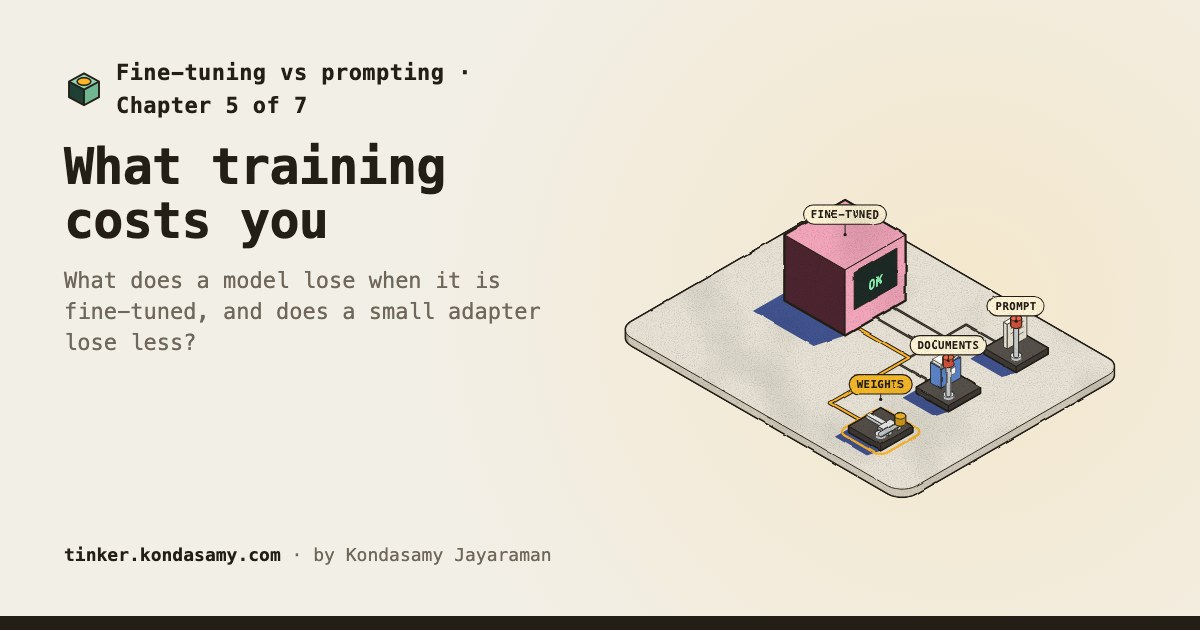
    What training costs you

    What does a model lose when it is fine-tuned, and does a small adapter lose less?

  6. Chapter 6

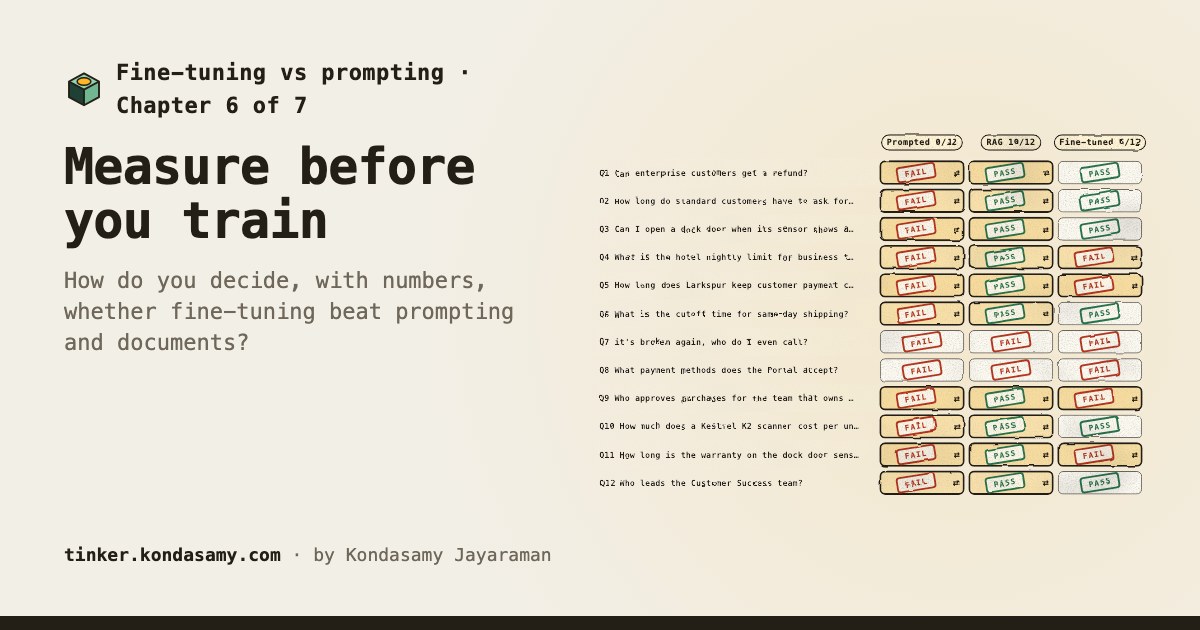
    Measure before you train

    How do you decide, with numbers, whether fine-tuning beat prompting and documents?

  7. Chapter 7

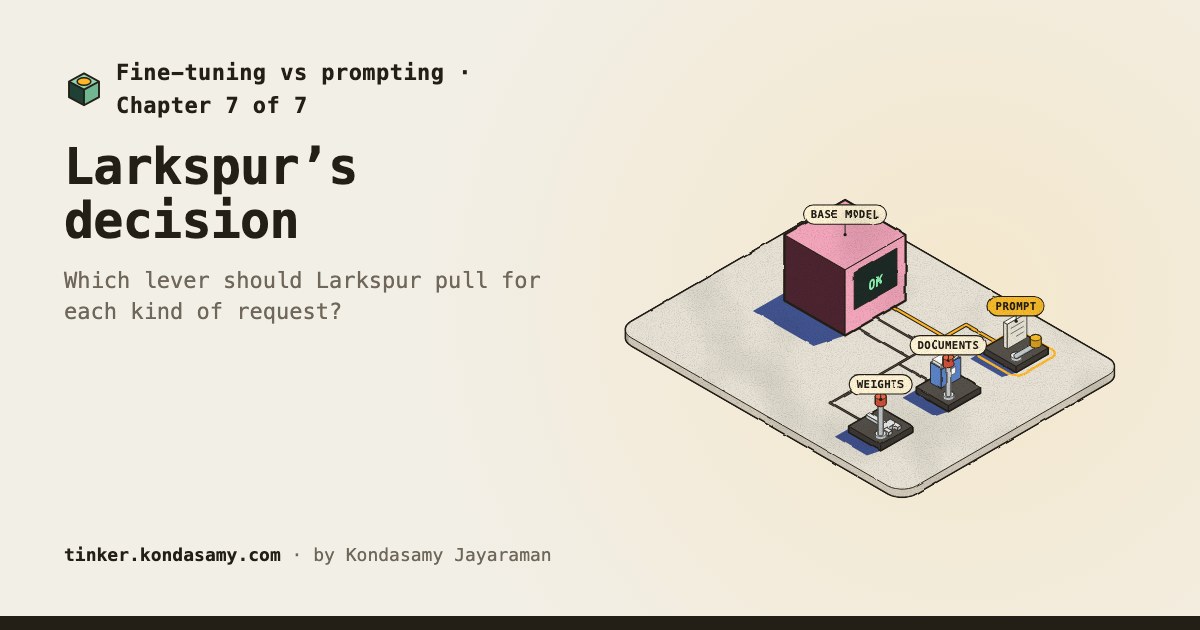
    Larkspur’s decision

    Which lever should Larkspur pull for each kind of request?

Who it’s for

  • Engineers
  • Product managers
  • Analysts
  • No code needed

Product managers, engineers and analysts deciding whether to train a model. Evals and Transformers come first; no code or maths needed.